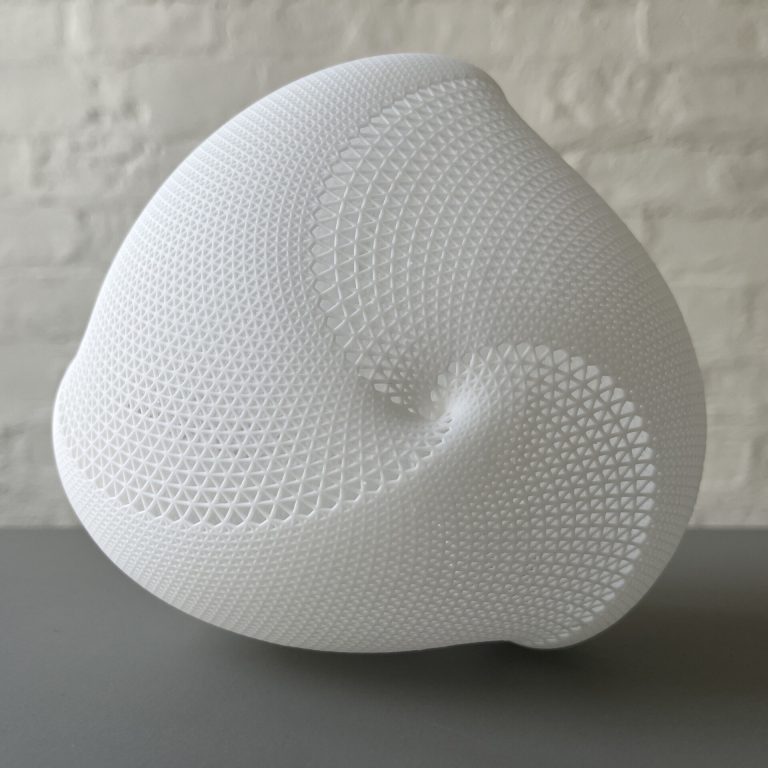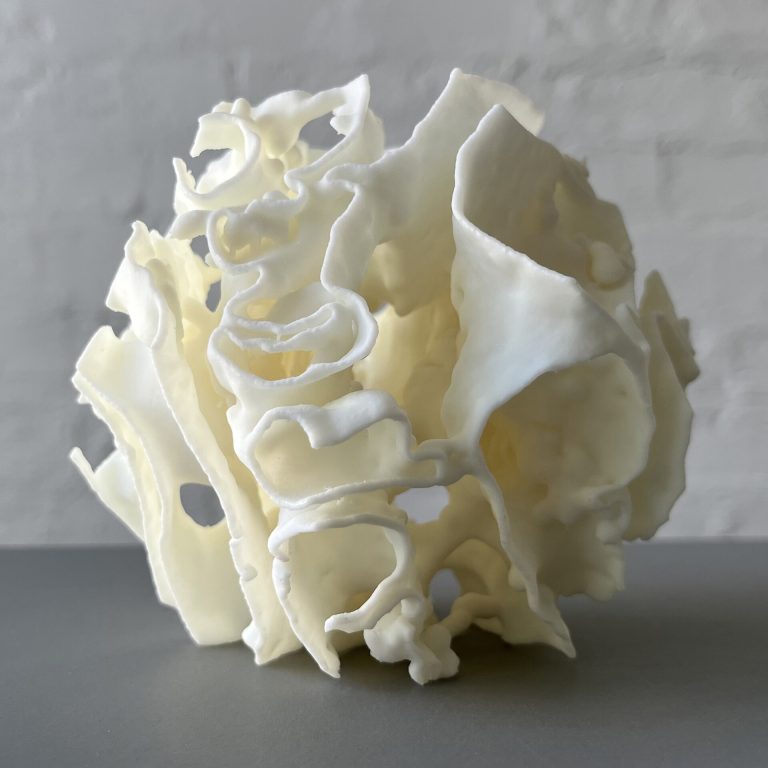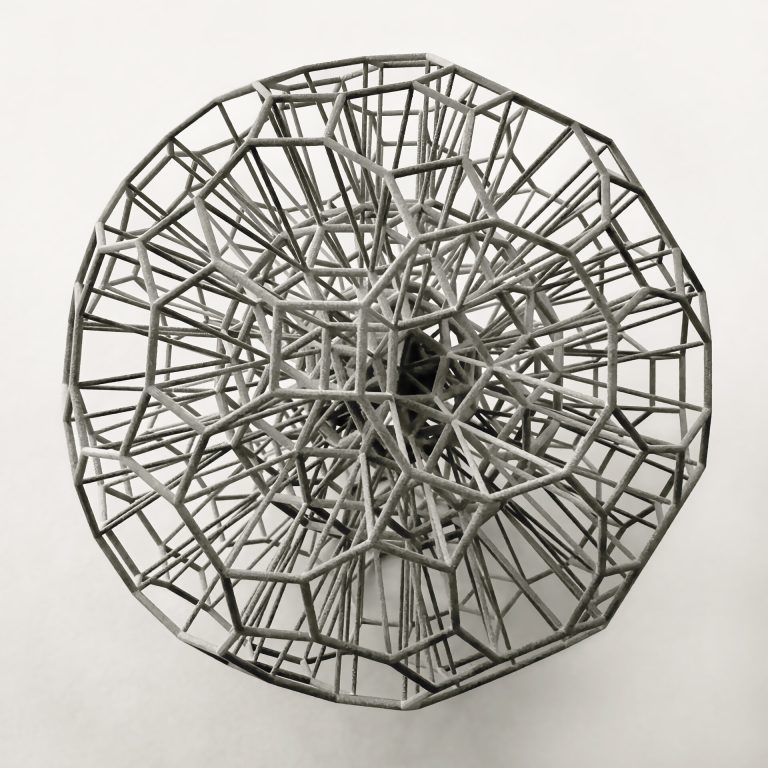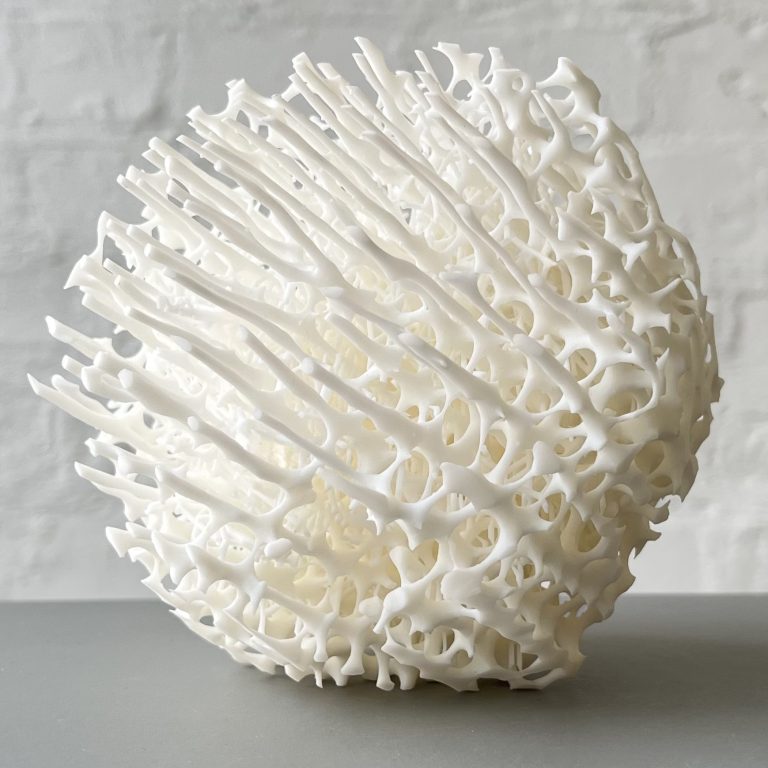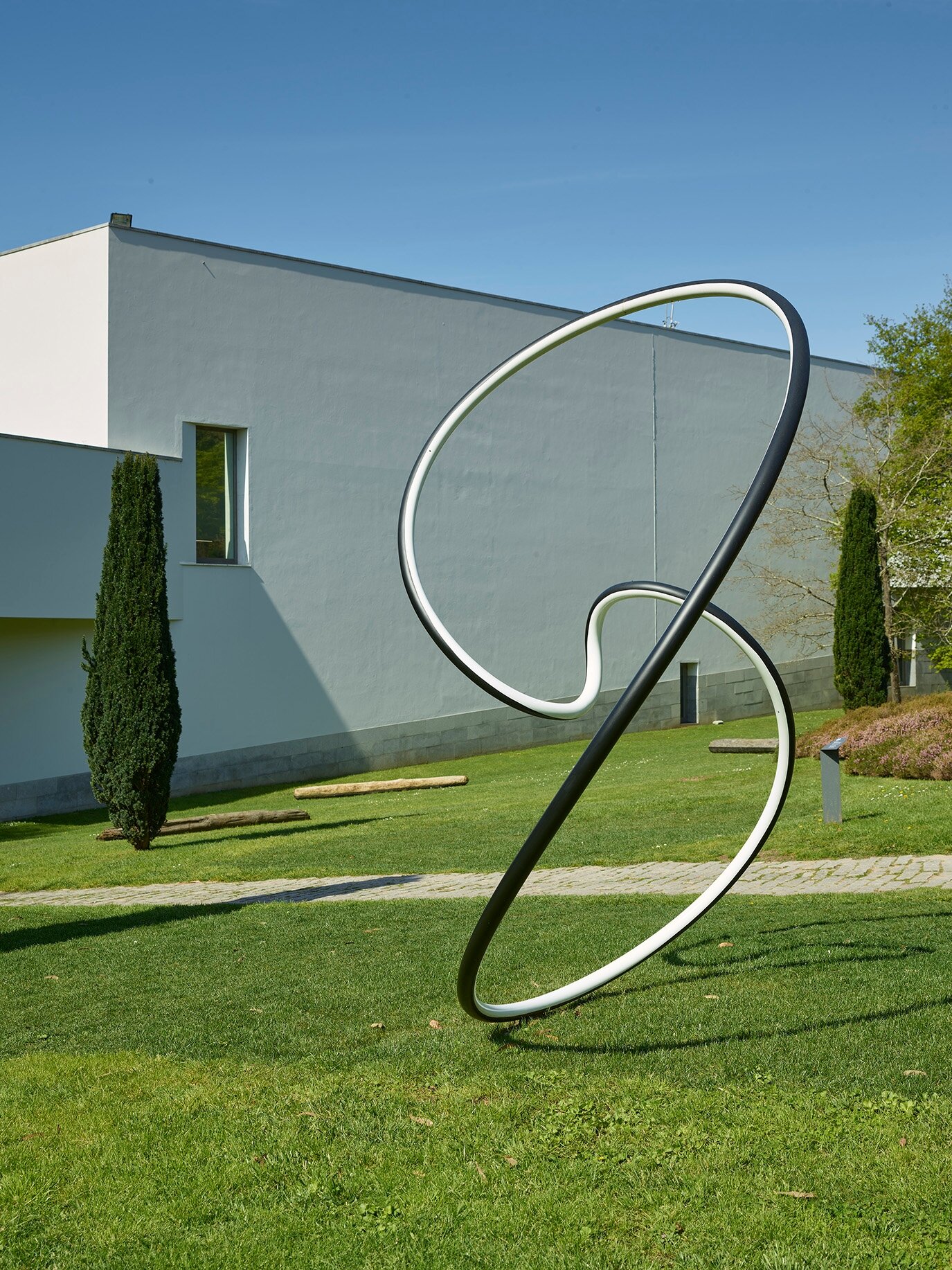
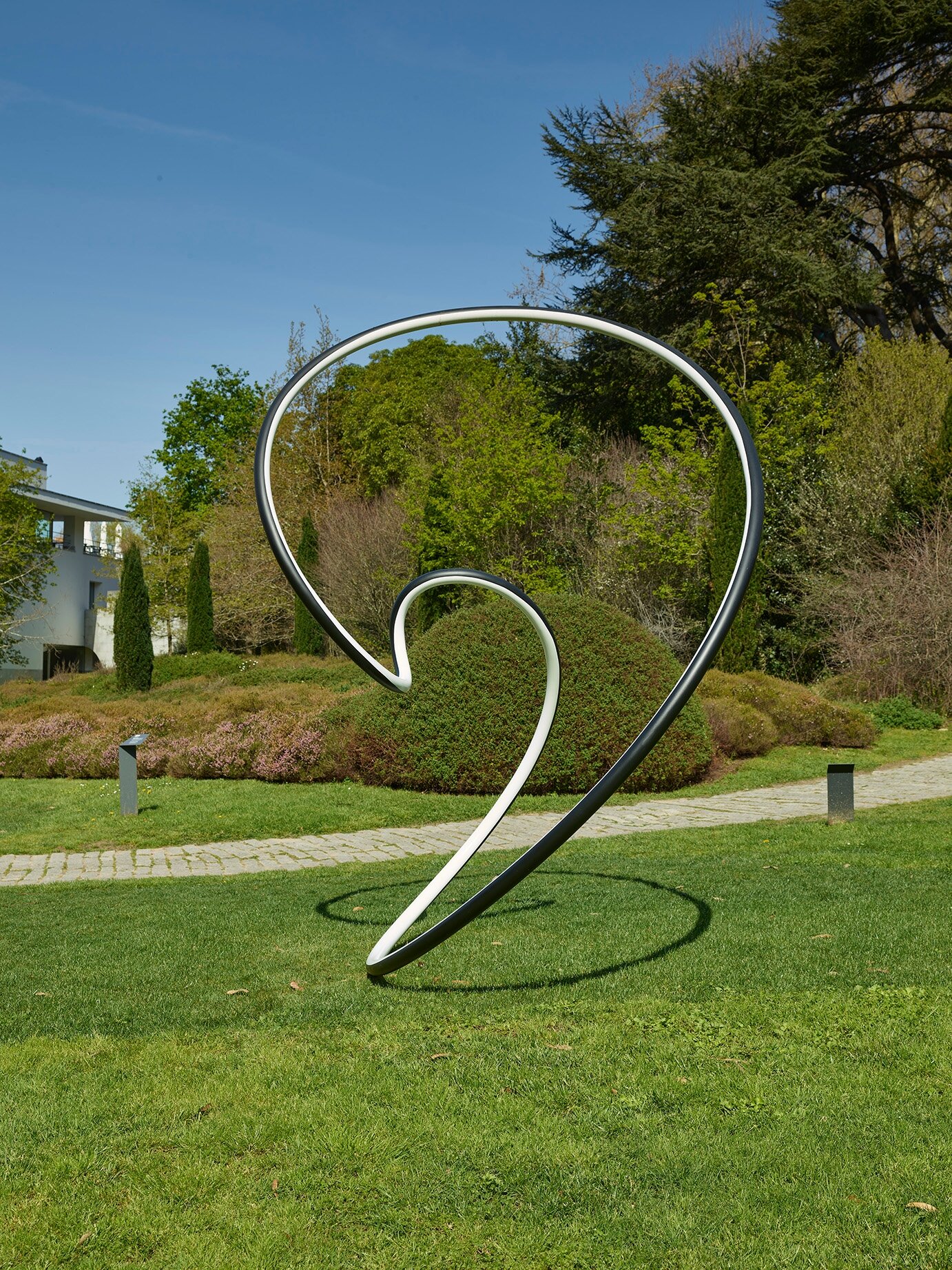
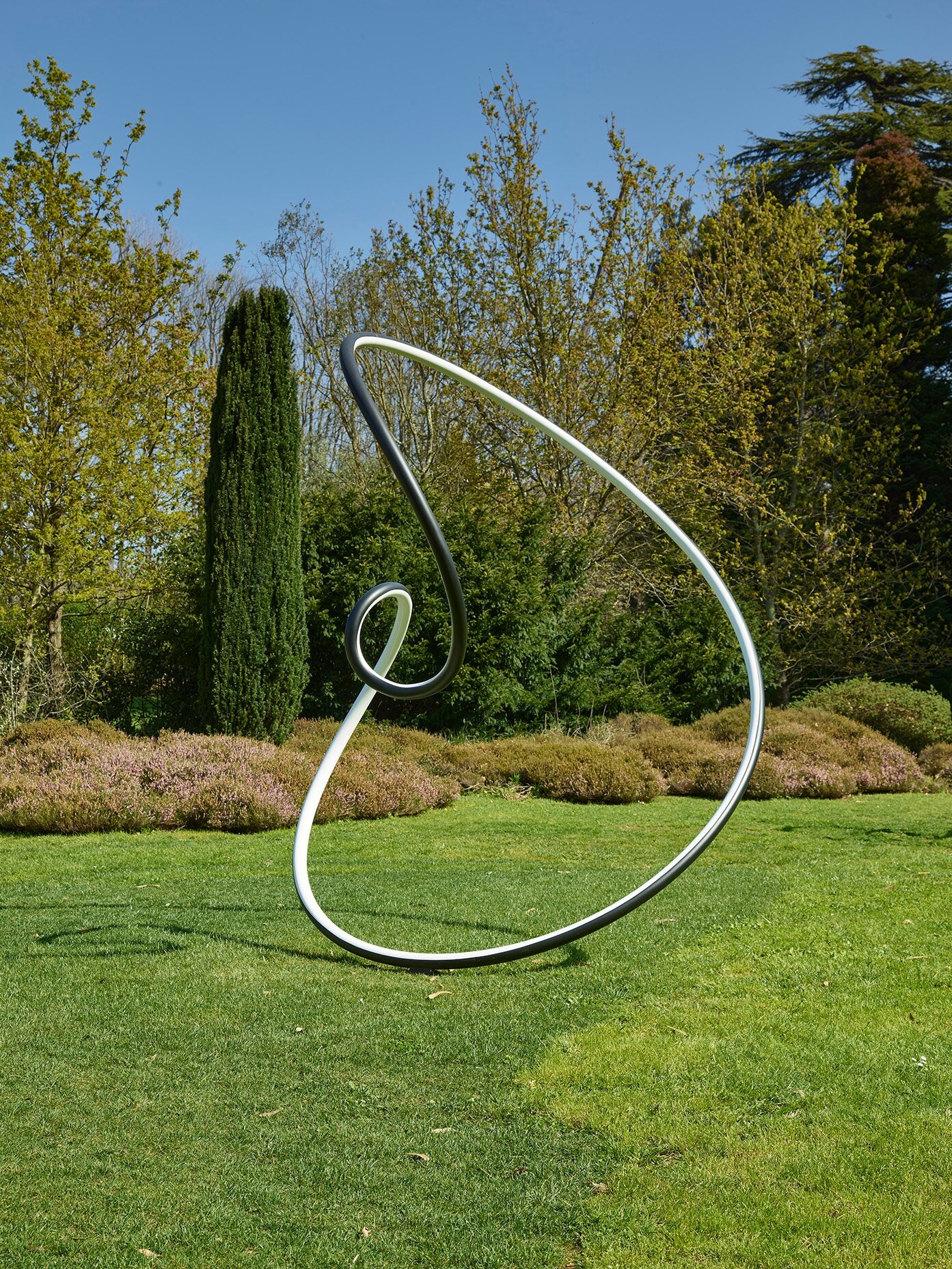
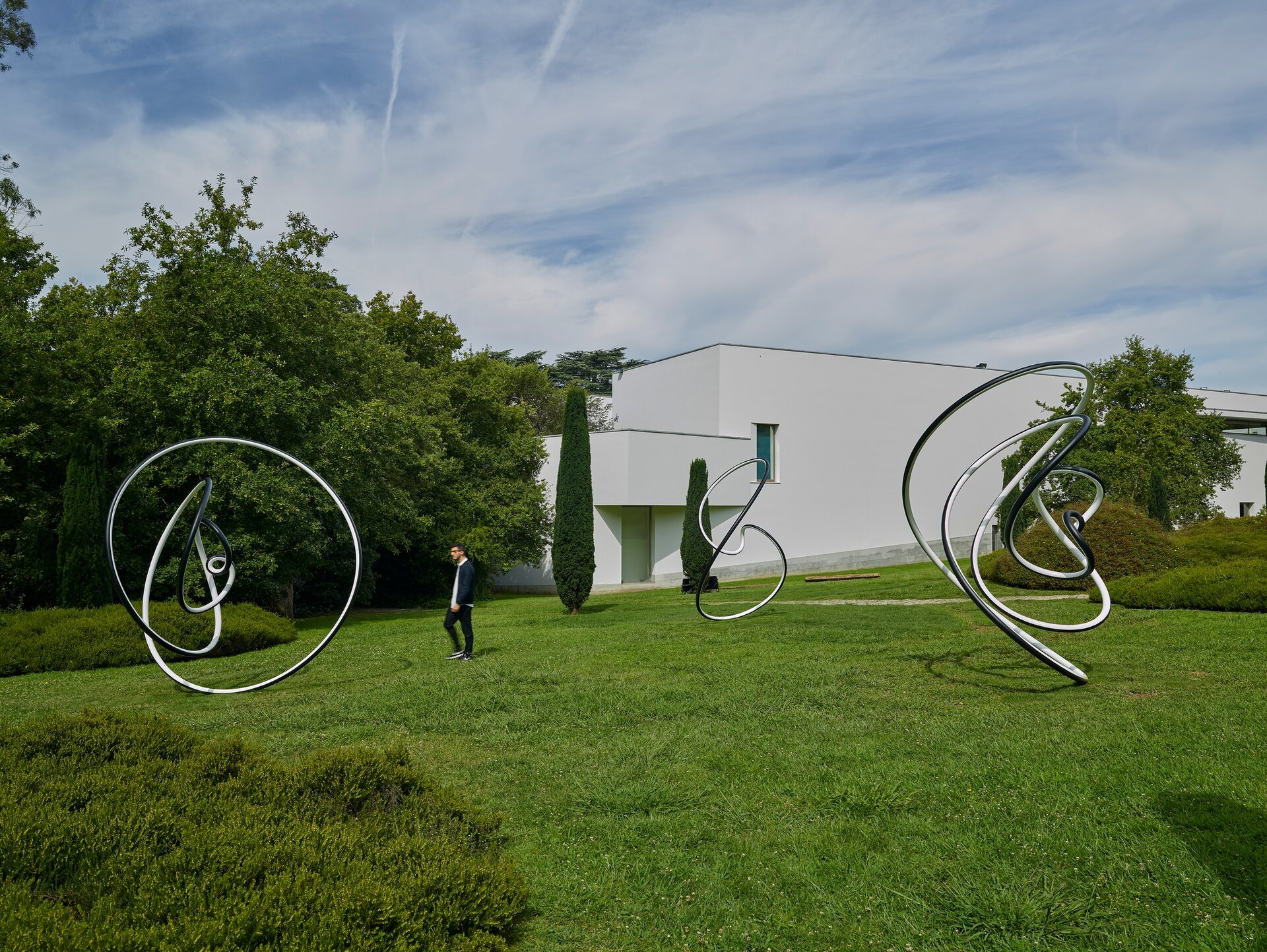
The Human time is movement works are variations on the mathematical form known as the Clelia curve. Named after the countess Clelia Grillo Borromeo by the early-eighteenth-century Italian mathematician Guido Grandi, the curve traces the progress of a point moving simultaneously along a sphere's meridian and rotating at constant speed around its axis. The resulting spherical curve corresponds to the way one peels an orange or winds up a ball of wool. The strikingly different forms seen in this series of works are produced by adjusting the speeds of rotation and by contracting the curve in towards the centre. The black and white paint scheme resembles the behaviour of a light source at the centre of each work – white indicating where the light would strike the form, and black where it would be in shadow – emphasising the physicality of the sculptures.
Research:
The Clelia curve is defined by a point moving along a sphere's meridian while the sphere rotates at constant speed about its axis. The research varied the ratio of meridian speed to axial rotation and applied a contraction factor toward the centre to produce the range of forms in the series. Parametric modeling allowed quick iteration over these parameters; the black-white paint pattern was derived from a central light source to reinforce the 3D shape.
Photography: Studio Olafur Elíasson, Filipe Braga
https://olafureliasson.net/artwork/human-time-is-movement-winter-2019/