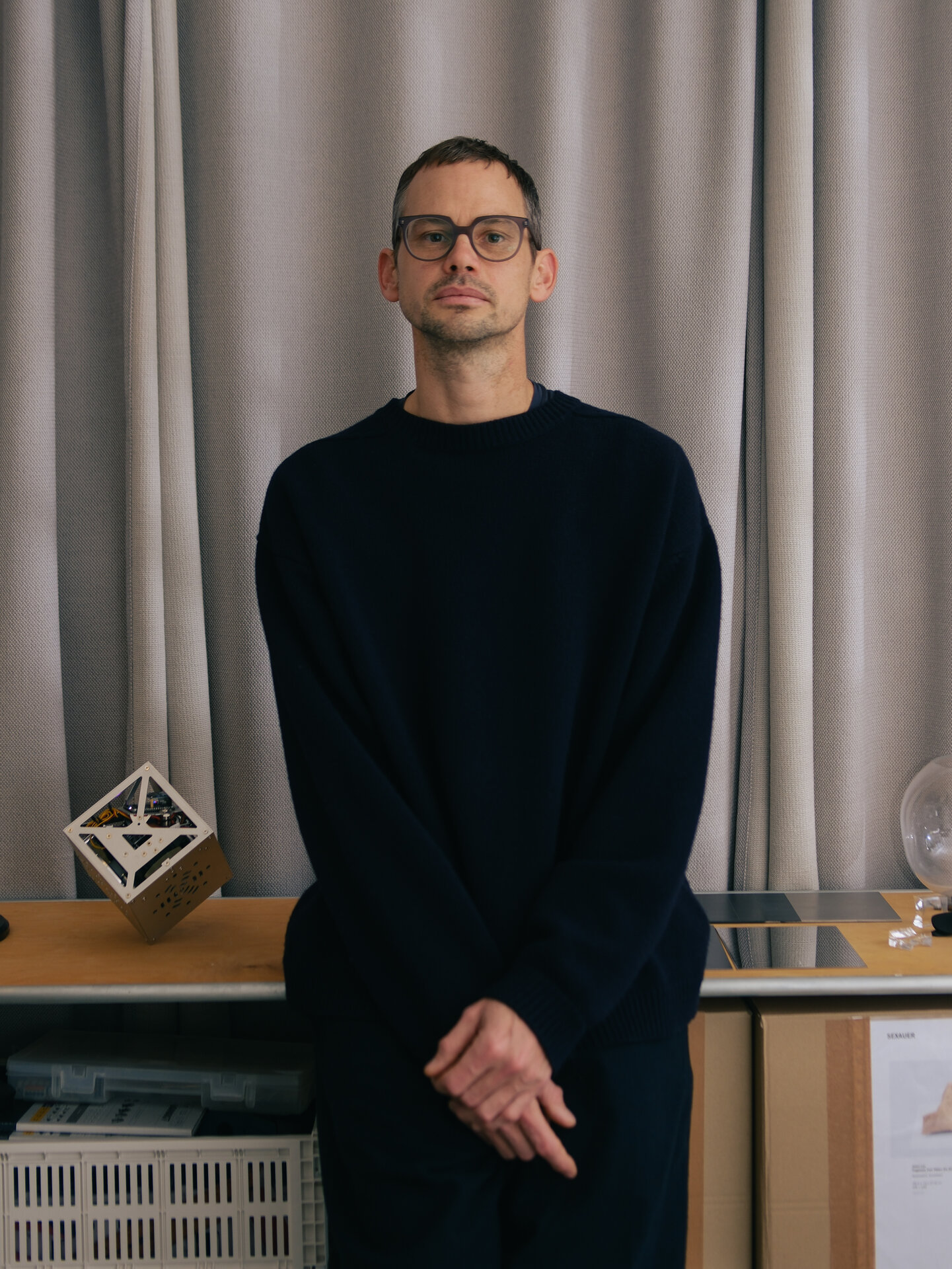
Phillip C. Reiner (b. 1981, Salzburg, Austria) is a german researcher, artist, and architect. He studied at Technical University Berlin, Berlin University of the Arts (UdK), and completed his architecture degree at University of Applied Arts Vienna under Studio Prix.
From 2010 to 2022, he worked at Studio Olafur Eliasson, where he established and led the Advanced Geometries Department (AID). He developed concepts from mathematical and natural phenomena and translated them into physical models and installations for large-scale projects exhibited worldwide. In 2015, he taught algorithmic design at the Department of Textil- and Surface-Design of Weißensee Kunsthochschule, Berlin.
In 2023, he founded protoCtrl in Berlin, an independent research platform for geometric, physical, and natural phenomena. The platform is an interdisciplinary space combining computational methods, material research, and artistic practice.
His work includes geometric fundamentals, algorithmic spatial formations, perceptual phenomena, alongside experimental acquisition and fabrication methods. Through collaborations with artists, scientists, and institutions, he develops projects ranging from research studies to site-specific installations.
His projects have been exhibited internationally.