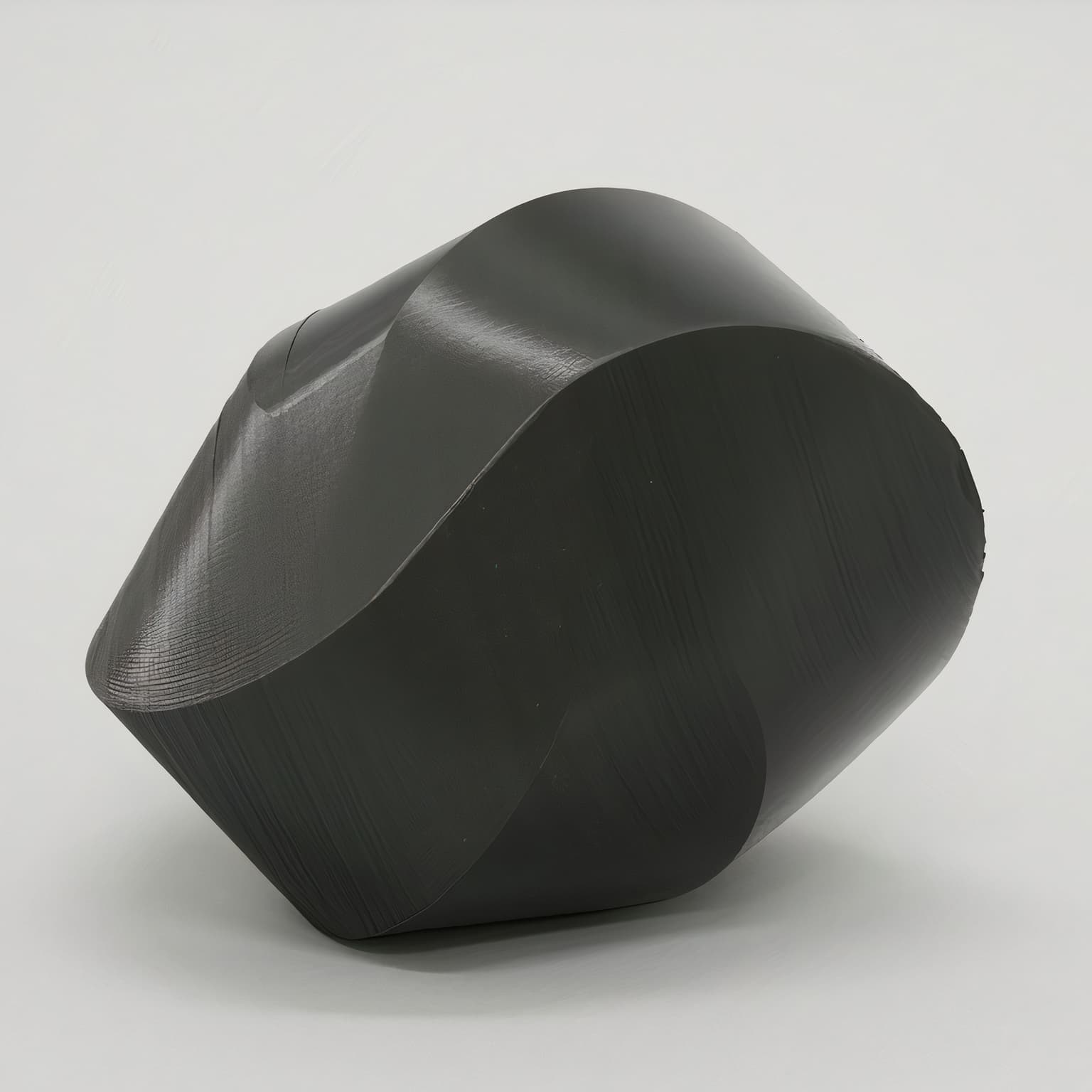
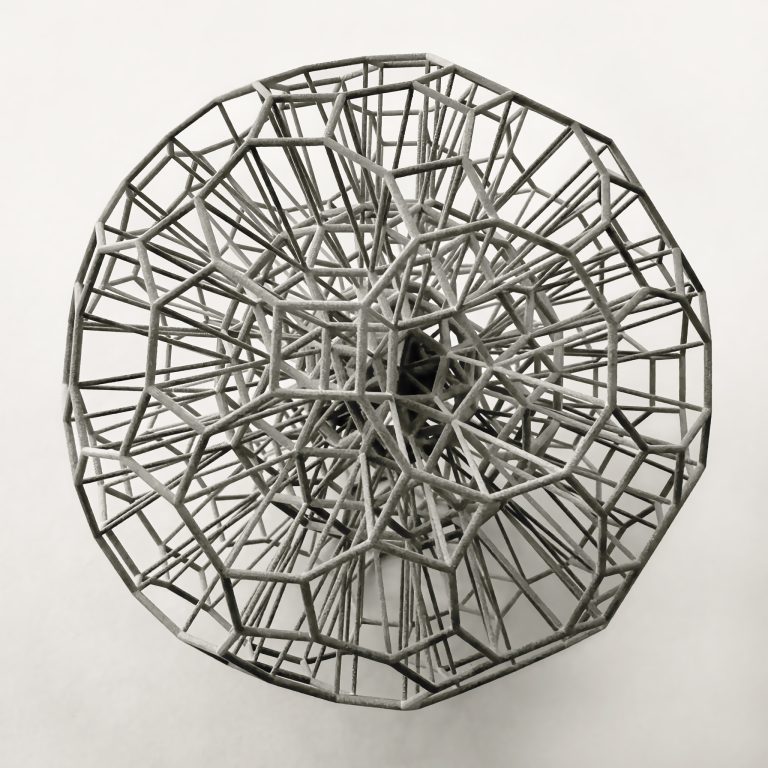
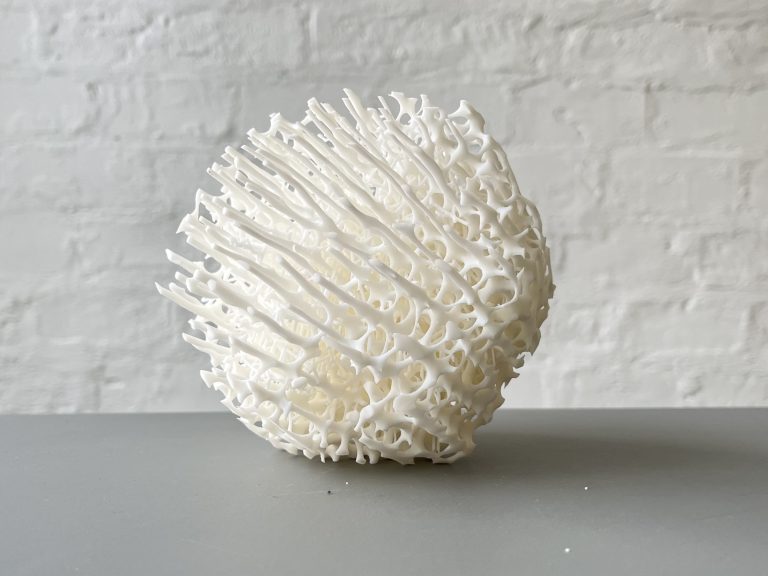
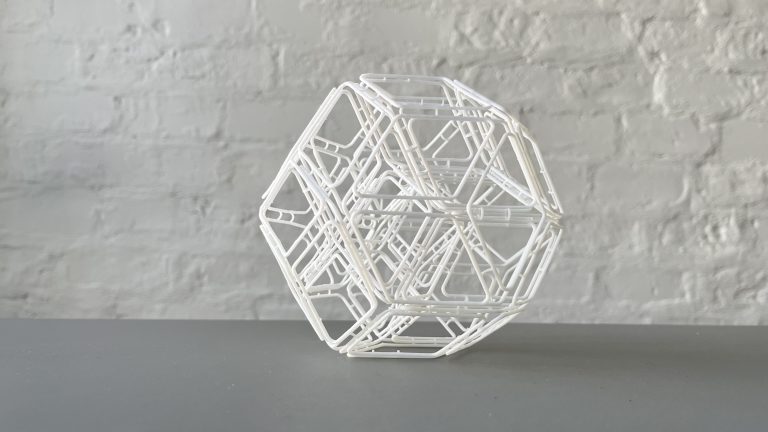
Triakaleidocycloid, created in 2019, derives from Paul Schatz's Oloid through systematic variation. Where the Oloid tracks edges of an invertible cube during its inversion cycle, Triakaleidocycloid tracks edges of triangular kaleidocycles. The prefix "tria" indicates the three-fold symmetry of the base kaleidocycle. As the kaleidocycle inverts through its kinematic sequence, selected edges trace paths in space. These paths, swept into surfaces, create the final form-a developable surface combining circular arcs and straight segments. The research extends Schatz's principle: kinematic inversion generates geometric form. By varying the base polyhedron from cube to triangle-based kaleidocycle, new families of rolling surfaces emerge. Each configuration produces distinct edge trajectories and surface characteristics.
Research: Edge-tracking during kaleidocycle inversion requires computational simulation of the kinematic chain. Each hinge rotation updates edge positions, with selected edges recorded through the full cycle. The resulting point clouds define swept surfaces, analyzed for developability. Developable surfaces can flatten without stretching-critical for fabrication. The computational pipeline tracks thousands of edge positions, interpolates smooth surfaces, and verifies developability through Gaussian curvature analysis. ABS printing captures the precise geometry needed for potential kinetic function.