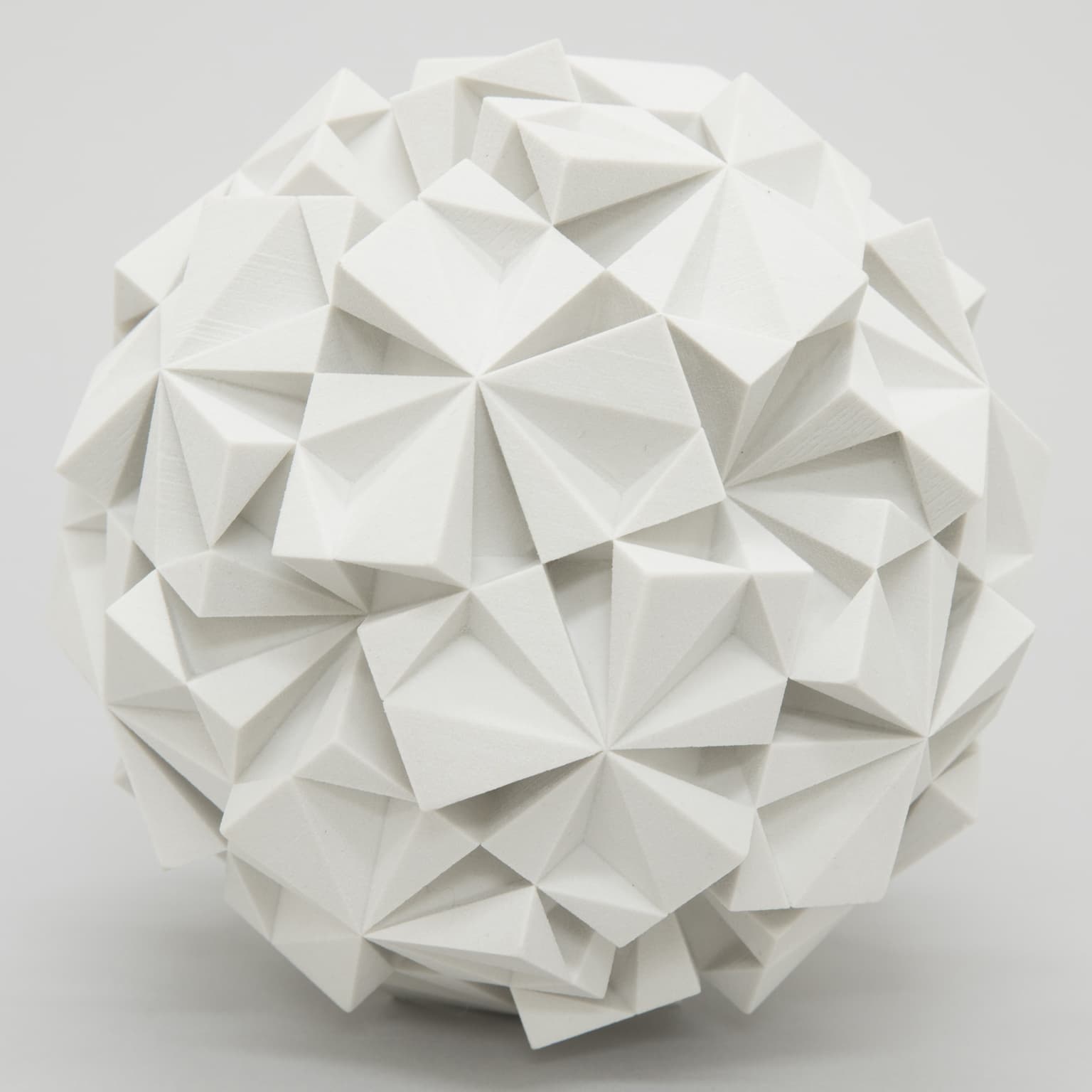
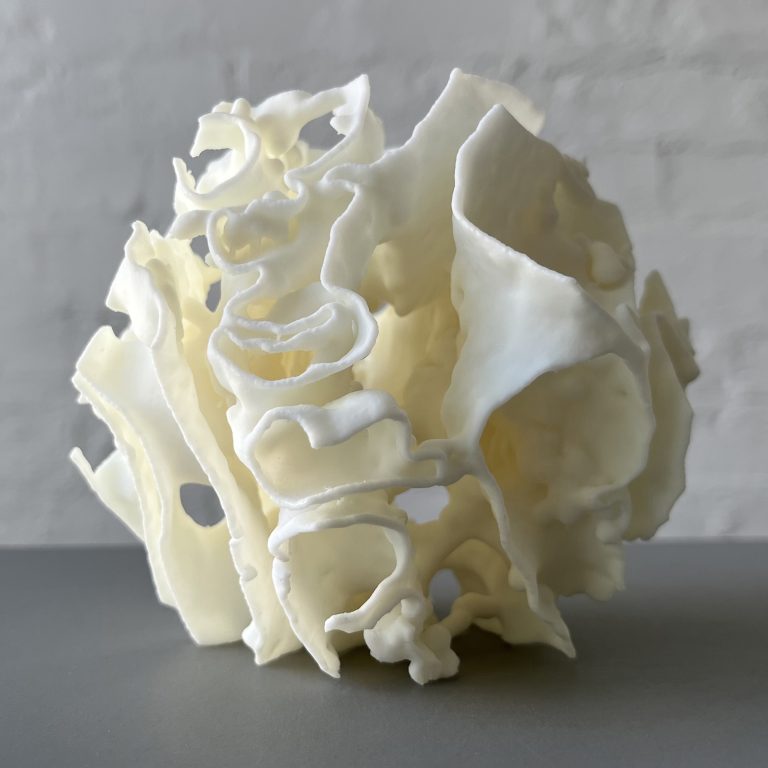
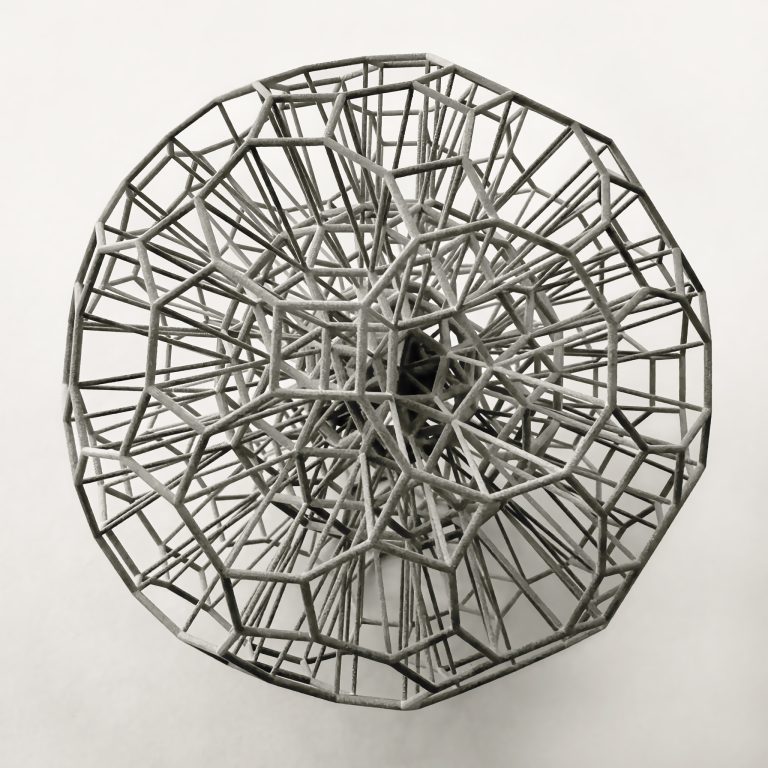
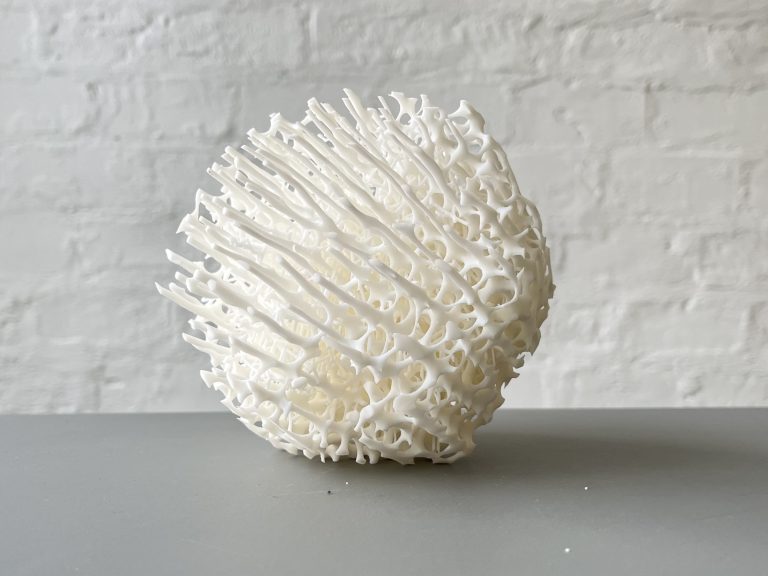
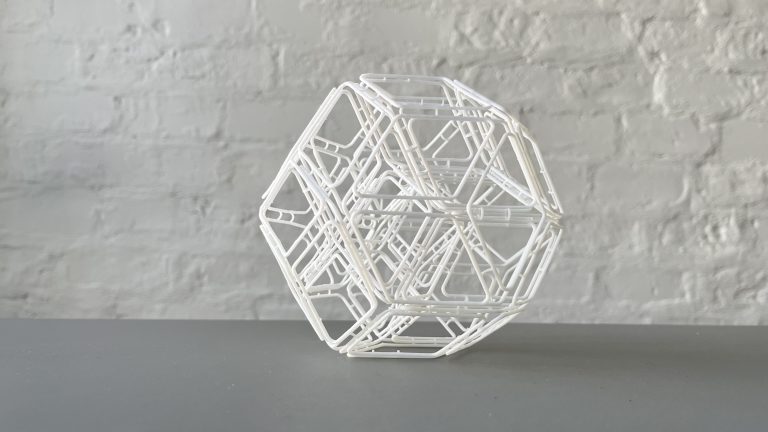
The SuperCubeSphere arranges 60 SuperCube modules in icosahedral symmetry. Each SuperCube derives from the five-cube compound-a cube with six tetrahedral indentations where edge divisions follow golden ratio proportions. The spherical configuration results from rotational transformations: three-cube triangular units align with icosahedral faces, five-cube pentagonal units orient along dodecahedral faces, four-cube arrangements form at edges. This 60-module assembly bridges different symmetry systems-the same modules that create periodic lattices also form icosahedral structures. The geometric relationships between Fuller's T-Quanta Module and the SuperCube's tetrahedral indentations connect this work to broader investigations of modular spatial systems. This research established foundations for many subsequent geometric studies.
Research: The SuperCubeSphere construction follows icosahedral symmetry principles. Starting from the five-cube compound, tetrahedral subtraction creates the SuperCube module through precise rotational relationships. Sixty modules organize into distinct cluster patterns: three cubes form triangular units, five cubes create pentagonal arrangements, and four cubes establish edge connections. The complete structure aligns with both icosadodecahedral and rhombic triacontahedral geometries-modules position at specific vertices while clusters orient along edges. Each arrangement type corresponds to different symmetry operations: three-fold rotation for triangular units, five-fold for pentagonal units, two-fold for edge configurations. These clusters interconnect through shared central cubes, creating a unified system. The geometry demonstrates how a single module type adapts to both periodic grid arrangements and five-fold symmetric spherical configurations through rotational logic.