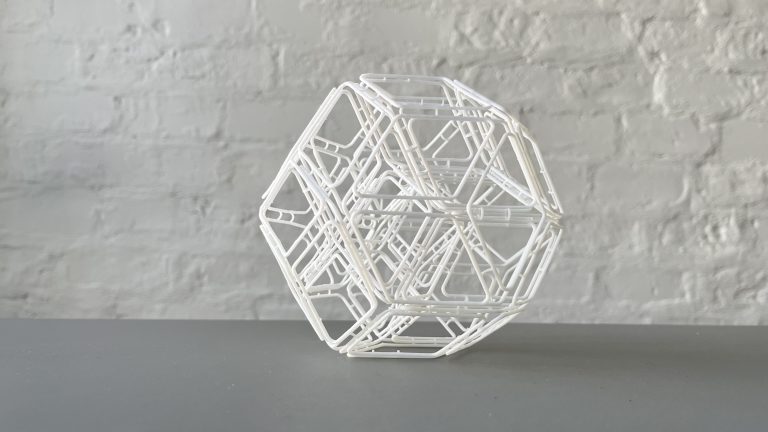
Dandelion Sphere – Phillip C. Reiner x Stefano Arrighi, 2021
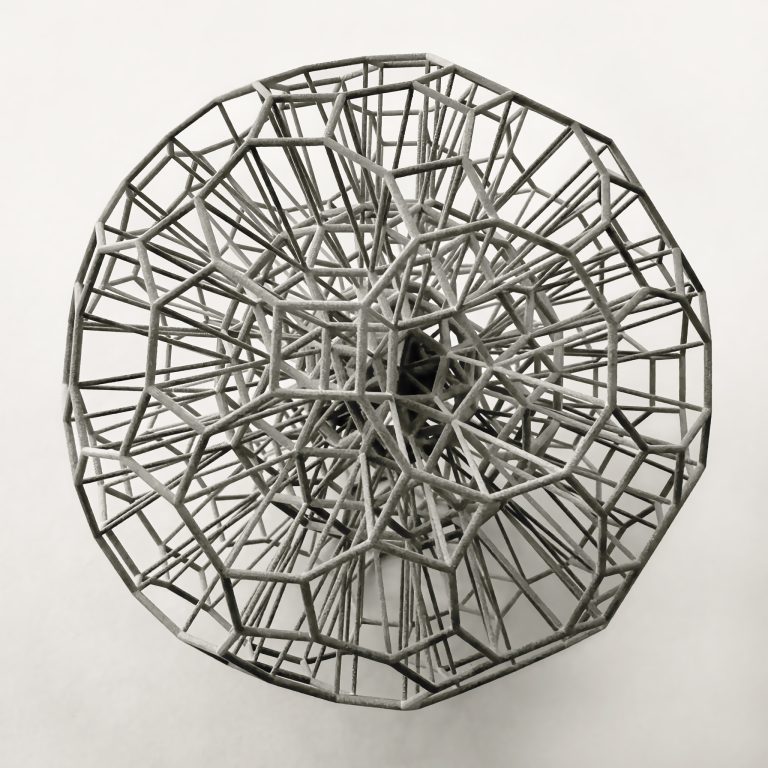
Dandelion Sphere establishes the foundational research for recursive polyhedral branching. Developed with Stefano Arrighi at AID, the project addresses a specific fabrication problem: how to automatically generate connectors for complex wireframe structures. Each branching node requires a unique 3D-printed joint connecting multiple struts at precise angles. The algorithm classifies nodes by their geometric configuration, identifies identical sets, and generates connector geometry accounting for chirality. The resulting sphere demonstrates the system-layers of polyhedra branch outward, each generation more complex. Wood struts connect through printed joints, making the algorithmic logic physically tangible. This prototype builds on earlier Dandelion Sphere explorations, adapting automated connector generation to handle exponential structural complexity through hybrid wood and printed joint construction.
Research: Node classification analyzes vector arrangements at each junction-angles between struts, connection count, spatial orientation. The algorithm groups geometrically identical nodes, accounting for mirror symmetry (chiral pairs). Connector generation creates 3D geometry for each node type: cylindrical sockets for struts, structural mass for strength, printable orientation. The system handles hundreds of unique node types across multiple branching generations. Wood and 3D-printed joints combine traditional and digital fabrication, testing hybrid construction methods for complex frameworks.